Though ramen is now considered to be a quintessential Japanese dish, its origins are closely tied to Chinese noodle traditions. This style of noodles arrived through Japan’s port cities and Chinese communities, before being incorporated into many Japanese ramen recipes. Over the following decades, the dish evolved to include many types of ramen with distinct regional styles, while its development became closely linked to industrialisation and Japan’s subsequent economic boom.
From Chinese noodles to Yokohama's Chinatown
Chinese immigrants and traders played a vital role in bringing wheat-noodle dishes to Japan through port cities including Yokohama, Kobe and Nagasaki. As a result, Yokohama’s Chinatown became an important centre of Chinese cuisine, serving noodle dishes that influenced the development of early ramen.
Some of these early dishes contained elements still found in ramen today, such as wheat noodles, sliced meat, bamboo shoots and spring onions. The precise origin is disputed, however, as there’s no single restaurant that can be credited with its invention.
How ramen became a dish of its own in Japan
Japanese cooks began adapting Chinese-style noodle soups, using local ingredients and seasonings including soy sauce, dashi and seafood. The use of kansui also gives ramen noodles their characteristic springy texture, helping to distinguish them from other wheat noodles.
In 1910, Rairaiken opened in Tokyo and is widely regarded as one of the influential early ramen restaurants. Its noodles and soup helped establish a recognisably Japanese style of the dish.
This period saw ramen become increasingly associated with inexpensive restaurant meals, particularly in urban areas, setting the stage for the regional variations that developed throughout the 20th century.
The post-war boom and the rise of instant ramen
After the Second World War, Japan faced severe food shortages and wheat supplied from the United States became an important part of the food supply. Wheat-based foods, including noodles, consequently became a vital component of the post-war diet, helping to support the growing popularity of ramen.
In 1958, Momofuku Ando invented instant ramen, fundamentally changing the way noodles could be consumed. It involved cooking, seasoning and flash-frying the noodles so they could be rehydrated later with hot water. In 1971, Nissin introduced Cup Noodles, making ramen noodles even more convenient and exporting Japanese-style noodles around the world.
The regional styles that followed: tonkotsu, shoyu, miso, shio
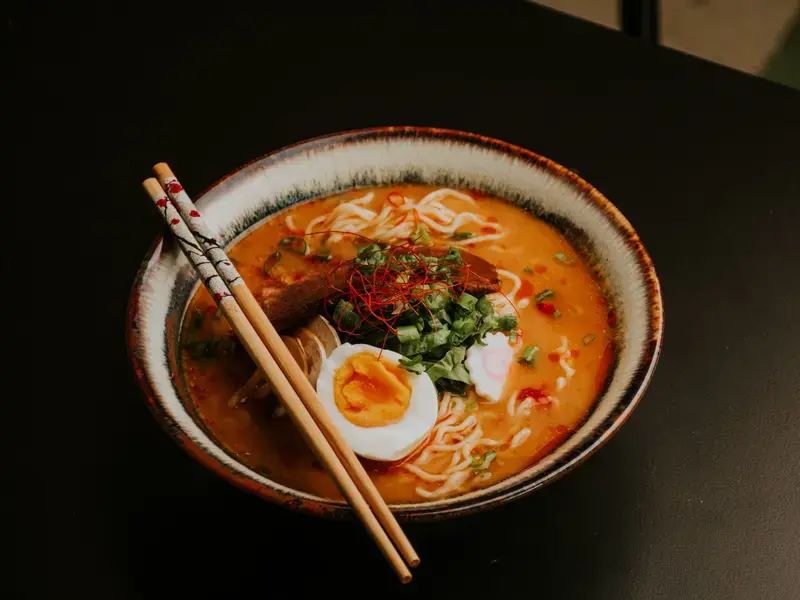
To understand the regional styles, it’s first helpful to know what ramen is. Ramen is generally made with Chinese-style wheat noodles, served in a seasoned broth or sauce and topped with ingredients such as pork, seaweed and eggs.
As it spread throughout Japan, regions developed their own versions. Shoyu ramen is seasoned with soy sauce and strongly associated with Tokyo, whereas shio ramen is characterised by a lighter, clearer broth. Miso ramen provides a rich and deeply savoury broth, and tonkotsu ramen is made using pork bones, simmered for long periods to produce a rich, opaque broth with a creamy appearance.
International variations have also emerged, with Korean ramyeon made using dried, curly noodles.
Ramen today: from street food to Michelin stars
Ramen is still an everyday food in Japan and there are specialist ramen-ya that serve bowls designed to be eaten quickly for a street-food style take on the dish.
Beyond these affordable beginnings, a new generation of chefs has transformed ramen into a highly technical dish. Every element of ramen, from the broth to the tare used for seasoning, provides an opportunity to bring a new level of detail to the recipe.
Ramen specialists will make their own noodles, ferment ingredients and develop complex, rich stocks over many hours to create elevated versions. There are also now ramen restaurants across Europe, North America and beyond that bring together Japanese techniques with local ingredients.
Michelin-starred restaurants in Tokyo have shown that the dish can be elevated to fine-dining cuisine, with highly experimental interpretations appearing alongside more traditional, casual and regional styles. Its evolution has been continual, influenced by Chinese cuisine, adapted by Japanese cooks, diversified across Japan’s regions and ultimately transformed into a global food.