Tired of giving and receiving the same old Secret Santa gifts from work colleagues, friends or family? Want to be the talk of the office Christmas do or the top gifter around the family table this year? Then try these edible and drinkable Secret Santa gift ideas from the UK’s best chefs, from a warm and aromatic spice mix to bite-sized madeleines, traditional Korean punch to ponzu.
Edible Secret Santa gift ideas from the UK's best chefs
Impress at work or at home with these edible (and drinkable) Secret Santa gift ideas from top chefs
05 Dec 2025
Laura Edwards
Kyu Jeon and Duncan Robertson, Bokman/Dongnae
Dried persimmons add a concentrated sweetness, a chewy texture and a deep, caramel-like aroma to traditional Korean sujeonggwa punch, pairing beautifully with the warm spices of ginger and cinnamon.
To make enough for a couple of 500ml bottles and a half bottle, combine 1.5l of water, 150g of fresh sliced ginger and 2-3 cinnamon sticks in a pot. Bring to a boil, then reduce the heat and simmer for 40–50 minutes until the flavour is deep and aromatic. Strain out the ginger and cinnamon. Add 120-150g of sugar to taste (and 1-2 tbsp of honey too, if you like) and simmer for another 5 minutes until dissolved. Add a handful of dried jujubes and 3-4 dried persimmons, then simmer for an additional 5–10 minutes. Cool completely, then refrigerate.
To serve warm, gently reheat over a low heat, but do not boil. Serve in a mug with a slice of dried persimmon or a few pine nuts. You can add a shot of dark rum, too.

Filippo Alessandri, The Ninth
This recipe for a warm, aromatic spice mix makes approximately 540g. I recommend about 60g per gift, meaning you’ll have plenty to share.
Start by gently toasting 200g of juniper berries, 200g of black peppercorns, 80g of star anise and 60g of cinnamon sticks. Once fragrant and slightly darkened, remove from the heat, allow to cool completely and then blitz to a fine powder. Allow the spice mix to sit for a few hours or overnight so the flavours combine. Spoon into airtight jars, tins or pouches ready for gifting. Best with roast potatoes or root vegetables, mulled wine or cider, poached fruit, or in marinades or rubs for meat (it works particularly well with game).
Photo credit: We the Food Snobs

Nathaniel Mortley, 2210
Jerk honey is one of those simple things that makes people think you’ve done madness and pairs perfectly with cheese boards, roast vegetables, chicken wings and more.
To make enough for two 150ml jars, gently warm 300g of honey in a small saucepan on low heat (40–50°C max). Don’t let it simmer. Add 1-1.5 teaspoons of jerk seasoning (or more to taste), a sprig of fresh thyme, one strip of orange peel (no pith), ½ teaspoon of lime zest, an optional small and lightly crushed clove of garlic, 1 teaspoon of fresh ginger, sliced and ½ a Scotch bonnet chilli, whole and pierced once. Let it infuse on the lowest heat for 15–20 minutes, swirling occasionally. Then add 1 teaspoon of apple cider vinegar and a pinch of salt; taste and adjust. You can strain for a clean look, or leave the aromatics in (but remove the Scotch bonnet). Allow the honey to cool completely, then pour into small sterilised jars. Seal and refrigerate for up to 4 weeks.
Photo by Danika Magdelena

Sam Carter, Margaret’s/Restaurant 22
This is a classic recipe for limoncello, or if you prefer, limecello. It makes roughly 1.5l; 50ml bottles make great gifts.
Wash and dry 12 lemons or 18 limes, then peel them carefully, avoiding the pith. Pour 750ml of vodka over the peels, then macerate in a dark place from 1 up to 6 weeks (the longer you leave it, the stronger the flavour). Make a 1:1 sugar syrup with 500ml of water and 500g of caster sugar, add 50ml of lemon or lime juice as it reaches a boil and then remove from the heat. Let cool before adding to the alcohol and citrus mixture. Leave to infuse overnight and then discard the peels. Finally, pour through a fine mesh strainer/cheesecloth. Keep in the fridge or freezer for up to 1 year.
Photo by Matt Hague

Emily Cuddeford and Rachel Morgan, Twelve Triangles
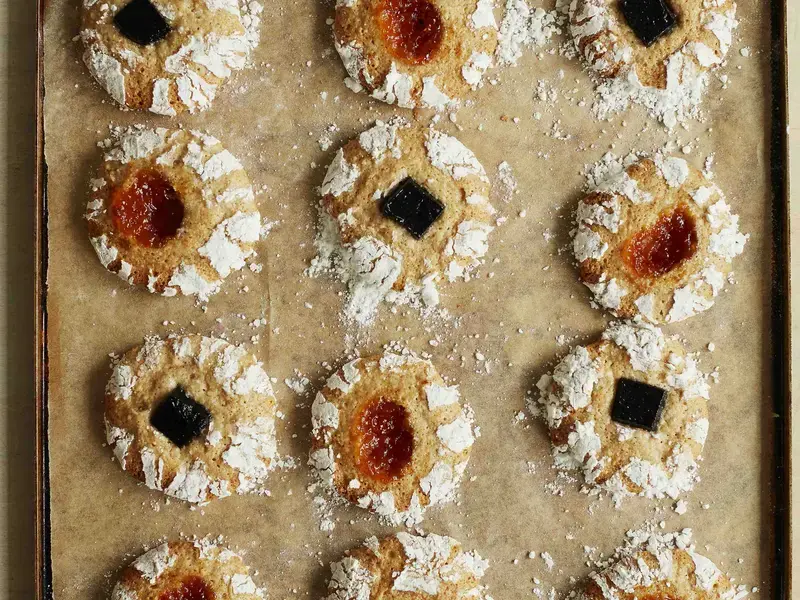
This recipe makes 18-20 chewy little hazelnut and jam biscuits [pictured top].
Roast 275g of hazelnuts (ideally blanched) at 160°C fan for around 15 minutes, until turning a light fudge colour. Then, blitz with 200g of icing sugar, the zest of ½ a lemon (save the juice), ¼ teaspoon of baking powder, and salt to a fine mix. Whisk 2 egg whites (approximately 60g) with the lemon juice until shiny and stiff. Fold the dry ingredients into the egg whites until evenly combined. Refrigerate for 4 hours or overnight.
When ready, shape into roughly 25-30g balls (a heaped teaspoon). Roll the dough balls in a bowl of icing sugar until covered. Place on 2 greaseproof paper-lined baking trays. They will spread to at least double their size, so leave plenty of room. Use the end of a teaspoon to push an indent into each ball, then fill with a little jam. Don’t fill above the hole, as it will spill out while baking. Bake for 14 minutes at 160°C fan – they will be very soft to touch, but will set while cooling; you want them to stay chewy in the middle. The edges should be a little coloured, and they will have cracked and look like they have split open. They will keep for well over a week in a sealed container.
Recipe taken from Kitchen Table: Simple Things Made Well by Emily Cuddeford and Rachel Morgan.

Connor Wilson, The Kirkstyle Inn
I love madeleines. These sweet and spiced bite-sized sponges are perfect at Christmas – or any time.
To make approximately 12-14 madeleines, whisk together 2 eggs, 100g of sugar, 35g of honey and 2g of salt. On the side, warm 60g of butter with 35g of whole milk until just above 38°C. Mix 120g of plain flour with 7g of baking powder, beat into the egg mix a third at a time, and then fold in the warmed milk and butter. Leave overnight in the fridge to rest.
When ready to bake, preheat the oven to 200°C. Lightly grease a madeleine or muffin tin and place a tablespoon full of the mixture into each of the buttered holes. Bake for 8-10 minutes, until risen and golden. They’re great served with a syrup of orange and spices (cloves, star anise, cinnamon).
Photo by Emma Giles (Northumberland Adventures)

Angelo Sato, Humble Chicken
Ponzu is a Japanese citrus sauce that goes well with a whole variety of foods, from sashimi and gyoza to grilled fish and salad. You can make it at home easily.
To make 250ml, combine roughly 80ml of soy sauce with 1 tablespoon of mirin, 2 tablespoons of rice vinegar and 3 tablespoons of water. The key ingredient is citrus – yuzu is ideal, but you can substitute with lemons if you can’t access it. 3 tablespoons should be about right, but adjust based on the citrus. Add a piece of kombu and some bonito flakes (or a shiitake mushroom for vegetarians) and steep for of minimum of 30 mins and up to a week. Strain and bottle.

Andy Beynon, Behind
This is a nougat recipe that combines the festive flavours of cranberry and nuts. The base is the most important thing to get right and then you can adjust the additional flavours if you so wish.
To make 15 large squares, begin by cooking 375g of caster sugar and 100g of glucose to 150°C. When it reaches 135°C, start whisking in 6 egg whites to form soft peaks. At the same time, cook 425g of honey with 200g of glucose. Add the honey and glucose mixture to the glucose and caster sugar mix and combine. When the mix is ready, warm a mix of nuts in the oven – I like 400g of flaked almonds, 150g of peeled hazelnuts and 150g of peeled pistachios – and fold in using a strong spoon along with 100g of cranberries. Wrap in edible rice paper.

Bart Stratfold, Montrose/Timberyard
My family and I like to make fruit jellies for cheese and roast meats at Christmas time – it’s a tradition. My dad’s speciality is crab apple and mine is damson jelly. There are a whole bunch of variations that can be made with any spare fruit you might have from Christmas Day cooking, as long as you have some pectin at home.
To fill 5-6 standard jam jars (340-380ml), I use about a kilo of damsons, one litre of good Scottish water, 800g of granulated sugar, 18g of yellow pectin and an equal amount of citric acid. Occasionally, I add a bit of spice of some kind. It’s a two-day process to get together, but very low effort.
Roughly chop all the damsons (skins, stones, everything), put them in a pan and simmer for 30 minutes in the water before leaving for a few hours and then straining through muslin. Tie the cloth with the fruit inside and hang somewhere cool, collecting the juice at the bottom. On day 2, measure out 1 litre of the juice and bring to a boil in a pan, before adding 700g of sugar. Once added, bring to the boil again with the pectin, citric acid and any toasted, ground-up spices. Mix well and bring to 105°C, then pour carefully into sterilised jars. Don’t touch the jars for 30 minutes as they will be very hot. Once cooled slightly, seal and store in a cool, dark place.

Laura and Pascal Wiedemann, Pompette
These parmesan biscuits are great with red wine; this recipe makes around 10 little gift packages. To give them a bit of extra festive frill, you could add shavings of black winter truffle, pesto and finely chopped sundried tomatoes, or cracked black pepper and rosemary.
Start by mixing 85g of softened butter, 90g of grated parmesan, 2g of baking powder, small pinches of sweet smoked paprika and cayenne, and freshly ground black pepper until well combined. Add 105g of sieved plain flour and combine without overworking, shape into an even-sized log, avoiding any air pockets, wrap in clingfilm and chill. Slice the biscuits to about 2-3mm thick, space them out evenly on a lined baking sheet and bake at 165°C for 10 minutes. Let cool.

Luke Selby, Palé Hall
This clotted cream and miso fudge is a refined take on a festive classic – rich, buttery and laced with sea salt for a clean mineral edge. The gentle savouriness of white miso brings depth and balance to the sweetness.
For around 25 pieces, cook 370g of caster sugar, 140g of golden syrup, 300g of clotted cream, 2 vanilla pods (split and scraped) and 8g of sea salt in a heavy-based pan over a medium heat until the mixture reaches 121°C. Transfer to a mixer and beat for around 5 minutes, until thick and creamy. Fold in 50g of white miso while still warm, ensuring it is evenly incorporated. Pour into a lined tray and allow to set at room temperature before cutting into squares. Wrap in edible rice paper.

Carlo Scotto, Bear
This black fig chutney has just been added to the tasting menu at Bear. It’s built around the deep, jammy sweetness of black figs and lifted by the acidity of foraged sloe berries, making it feel both rustic and refined.
Place 1l of organic apple cider vinegar, 700g of high quality honey, 10g of dried meadowsweet, 20 of dried juniper berries, 20 pink peppercorns, 5g of fresh bay leaf (1–2 leaves), 100g of sloe gin, 100g of fresh foraged sloe berries and 1kg of roughly chopped black figs in a pan and gently bring to a simmer. Let the mixture bubble away on a low heat, stirring continuously until the ingredients soften and the mixture transforms into a rich, glossy chutney with a jam-like consistency. The recipe makes 1.3kg of chutney, so depending on your jar size, usually 4-6 gifts.
Photo credit: @lateef.photography

Tom Waters, Gorse
Piccalilli is a tangy, crunchy relish, perfect for an edible Secret Santa gift. This recipe makes roughly 10-12, 200-250ml jars.
First, make a brine by dissolving 150g of salt in 3 litres of water. Then add diced and sliced vegetables: 250g of broccoli, 200g of red onion, 200g of cucumber, 100g of fine green beans, 100g of runner beans, 100g of fennel and 100g of small silverskin onion, and refrigerate for 24 hours.
For the sauce, simmer 450g of cider vinegar, 35g of yellow mustard seeds, 225g of caster sugar, 4 sliced birdseye chillies and 300g of finely diced shallots for around 10 minutes until both the chillies and shallots have lost their rawness. Whisk in 20g of turmeric and 50g of English mustard. Add 15g of cornflour dissolved in water gradually, whisking continuously to incorporate smoothly.
Meanwhile, drain the brined vegetables, discarding the liquid, and place in a large bowl. While the liquid is hot and smooth, pour it over the vegetables and stir well with a clean spoon. Check for seasoning and add a touch of salt if necessary. Spoon the piccalilli into sterilised jars and leave to cool completely. Transfer to the fridge and seal the jars when cooled. The flavours will deepen over the next few days.
Photo by Will Barker


About the author
Tom Jenkins is a London-based journalist and editor for Fine Dining Lovers. He is particularly interested in how the food community can come together to make great food more...



Read more








Get your free hot trends guide
Sign up for our monthly round-up of foodie inspiration and unlock our exclusive guide to what's hot in food and drink this year.
Get your free plating guide
Sign up for our monthly round-up of foodie inspiration and receive our exclusive plating guide free.
Discover your next fav spot
Sign up for our monthly round-up of foodie inspiration and receive our exclusive restaurant guide free.